
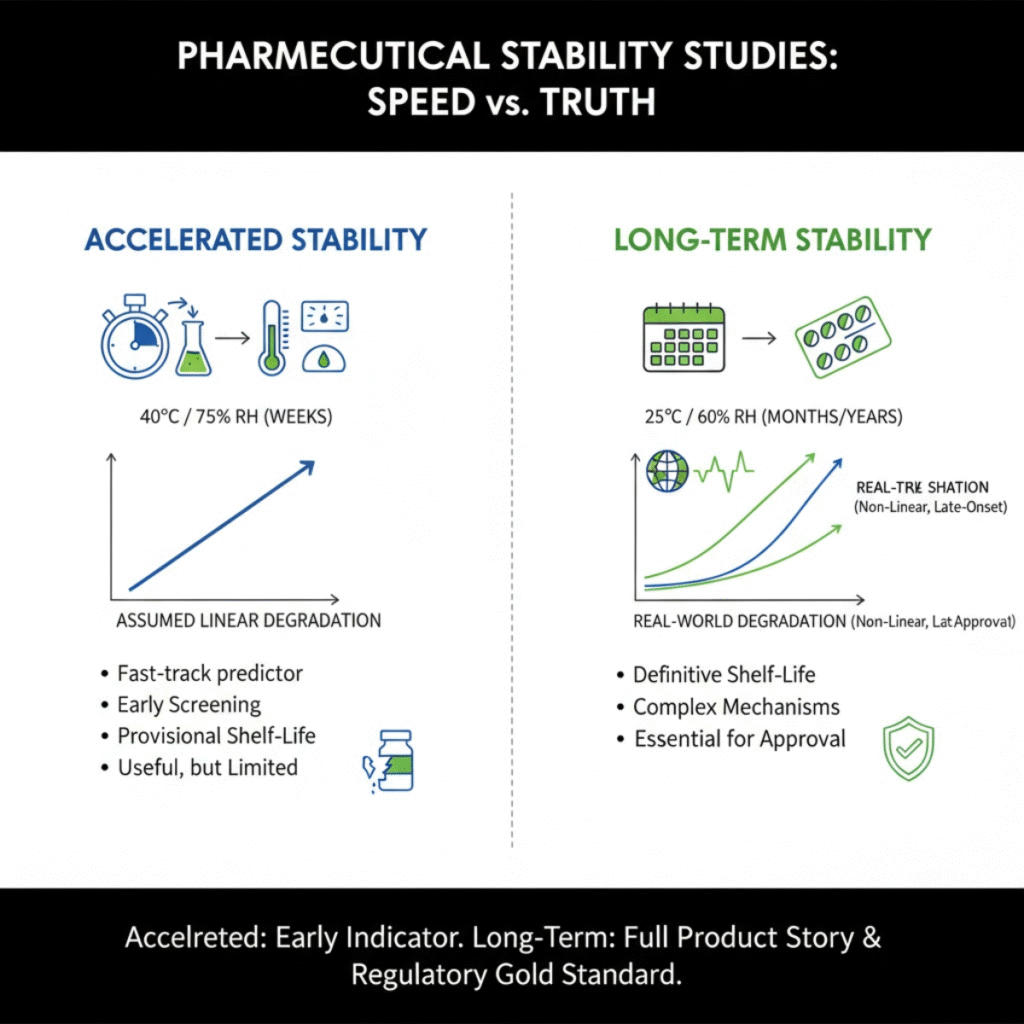
In pharmaceutical development, accelerated stability studies are often viewed as a fast-track predictor of product behavior. They are valuable, efficient, and required by regulatory guidelines. However, accelerated data was never intended to replace long-term stability data. Instead, it serves as an early indicator — not the full story.
What long-term stability data reveals over months and years is fundamentally different from what accelerated studies can show in a matter of weeks. Understanding this distinction is critical for defensible shelf-life claims, robust regulatory submissions, and real-world product performance.
Accelerated Stability: Useful, but Limited by Design
Accelerated stability studies typically expose products to elevated temperature and humidity conditions (such as 40°C/75% RH) to induce degradation more rapidly. This approach is grounded in sound scientific principles, particularly the Arrhenius equation, which correlates reaction rate with temperature.
However, accelerated conditions compress time, and in doing so, they can oversimplify complex degradation mechanisms.
Accelerated studies are effective for:
- Early formulation screening
- Detecting obvious instability
- Supporting provisional shelf-life during development
But they operate on an assumption that degradation pathways remain consistent across time and conditions — an assumption that does not always hold true.
What Long-Term Stability Data Reveals That Accelerated Studies Cannot
1. Non-Linear Degradation Behavior
Accelerated studies often assume degradation follows a predictable, linear trend. Long-term data frequently shows otherwise.
Over extended storage:
- Degradation may plateau after an initial phase
- New degradation pathways may emerge later
- Interactions between excipients and APIs can evolve slowly
These patterns only become visible through long-term observation under real storage conditions.
2. Late-Onset Instability
Some products appear stable under accelerated conditions but begin to fail specifications after prolonged real-time storage.
Examples include:
- Gradual moisture ingress through packaging
- Slow oxidation processes
- Polymer relaxation in container-closure systems
Accelerated studies may not replicate these slow, cumulative effects accurately.
3. Packaging Performance Over Time
Packaging systems behave differently over years than they do over weeks.
Long-term stability data reveals:
- Changes in moisture vapor transmission rates
- Seal integrity degradation
- Interaction between packaging materials and formulation
Accelerated conditions may stress packaging, but they cannot fully simulate time-dependent material aging.
4. Excipient and API Interaction Evolution
Certain excipient-related degradation mechanisms are time-dependent rather than temperature-dependent.
Long-term studies can uncover:
- Gradual pH drift in liquid formulations
- Slow Maillard reactions
- Migration of plasticizers or additives
These interactions may remain undetected in short-duration accelerated studies.
5. Real-World Storage Variability
Long-term studies reflect:
- Normal temperature fluctuations
- Routine door openings
- Minor environmental variations
These real-use conditions influence stability outcomes in ways that controlled accelerated studies cannot replicate.
Regulatory Perspective: Why Long-Term Data Remains Non-Negotiable
International guidelines (including ICH stability guidance) consistently emphasize that long-term stability data forms the primary basis for shelf-life assignment.
Accelerated data may support:
- Interim shelf-life
- Trend analysis
- Risk assessment
But regulatory authorities rely on long-term data to:
- Confirm degradation trends
- Validate storage statements
- Ensure patient safety over the entire product lifecycle
Submissions that lean too heavily on accelerated data often face increased scrutiny during review or inspection.
The Strategic Role of Long-Term Stability Studies
Long-term stability studies are not merely a regulatory requirement; they are a strategic asset across the pharmaceutical product lifecycle. The data generated over real-time storage provides the foundation for decisions that directly impact product quality, regulatory confidence, and commercial viability.
From a development perspective, long-term data validates whether early formulation and packaging decisions truly withstand real-world conditions. It confirms that degradation pathways remain controlled, excipient interactions stay within acceptable limits, and container-closure systems continue to protect the product over time — not just under artificial stress.
From a regulatory standpoint, long-term stability data forms the primary scientific justification for shelf-life assignment. Regulatory authorities rely on these datasets to assess whether expiry dates, storage statements, and distribution conditions are realistic, reproducible, and defensible throughout the product’s intended lifecycle.
Operationally, long-term stability data informs:
- Storage and distribution strategies across climatic zones
- Risk-based decisions for supply chain excursions
- Lifecycle management, including shelf-life extensions and post-approval changes
- Global market access planning, especially for regions with demanding climatic conditions
Commercially, robust long-term stability programs reduce uncertainty. They minimize the risk of late-stage failures, product recalls, and market withdrawals, while enabling confident forecasting, inventory planning, and global expansion.
In short, long-term stability studies transform stability testing from a compliance exercise into a risk-management and value-protection function.
Conclusion
Accelerated stability studies provide speed. Long-term stability studies provide truth.
While accelerated testing helps identify early risks and supports initial development decisions, it is long-term stability data that ultimately defines how a pharmaceutical product behaves over time — under the conditions it will actually experience throughout manufacturing, storage, distribution, and patient use.
Long-term studies reveal slow, cumulative degradation mechanisms, packaging performance changes, and formulation interactions that cannot be reliably predicted through compressed testing alone. They underpin credible shelf-life claims, defensible regulatory submissions, and sustained patient safety.
In an industry where regulatory expectations are rising, formulations are becoming more complex, and global distribution is the norm, reliance on accelerated data alone is no longer sufficient. True product assurance comes from time, evidence, and consistency.
For pharmaceutical organizations committed to quality, compliance, and long-term market success, investing in robust long-term stability studies is not optional — it is fundamental to building trust in both the product and the science behind it.