
Why Annual Mapping May Not Be Enough
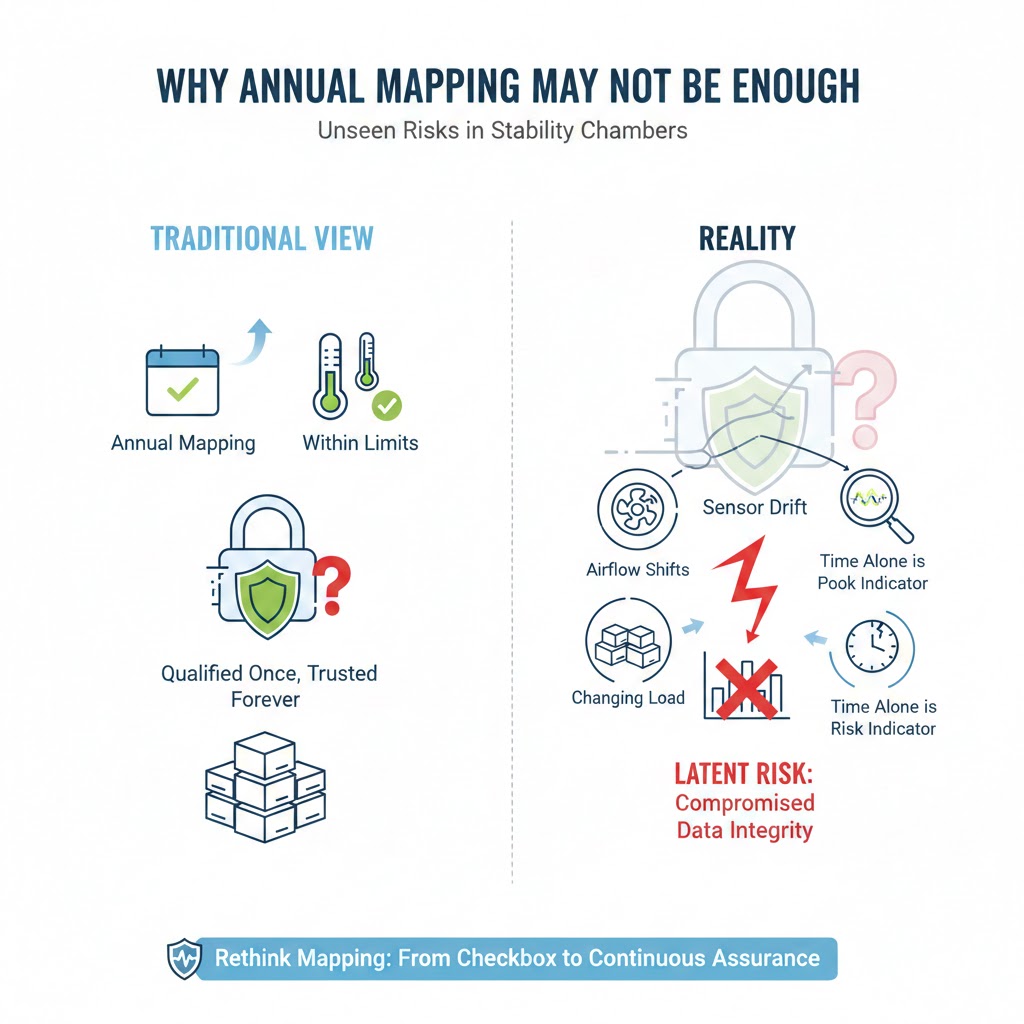
Stability chambers are often treated as “qualified once, trusted forever” assets. After initial qualification and a scheduled annual re-mapping, they quietly fade into the background of routine operations. As long as temperature and humidity readings remain within limits, confidence tends to remain high.
However, in practice, stability chamber performance is not static. Environmental control systems age, airflow patterns evolve, sensors drift, and loading conditions change. Infrequent mapping does not always capture these gradual shifts. The result is a category of risk that rarely appears in deviation logs—but can quietly undermine the reliability of stability data.
What Stability Chamber Mapping Is Meant to Demonstrate
At its core, stability chamber mapping is intended to establish that:
- Temperature and humidity are uniformly distributed within the usable space
- Worst-case locations are identified and understood
- Environmental conditions remain within defined acceptance criteria under normal operating conditions
Mapping validates the environmental behavior of the chamber, not just the performance of a single sensor.
However, mapping represents a snapshot in time, not a permanent guarantee.
How Chamber Behavior Changes Over Time
Even well-maintained chambers experience gradual changes that are not always visible through routine monitoring.
1. Airflow Patterns Are Not Permanent
Air distribution depends on:
- Fan performance
- Duct cleanliness
- Internal baffles and airflow guides
Over time, airflow can shift due to dust accumulation, mechanical wear, or minor internal modifications. These changes can create new hot spots or humidity gradients that were not present during the last mapping exercise.
Routine sensors may not be positioned to detect these emerging non-uniformities.
2. Sensor Drift Masks Localized Variability
Continuous monitoring typically relies on one or two control probes. While these sensors may remain calibrated, they represent only a limited location.
Meanwhile:
- Peripheral zones may experience excursions
- High-load areas may respond differently to environmental stress
- Door-adjacent regions may see repeated transient disturbances
Without periodic spatial re-mapping, these localized variations remain undocumented.
3. Loading Patterns Change the Chamber’s Thermal Profile
Mapping is often performed under defined or minimal load conditions. In real operation, chambers rarely remain static.
Changes include:
- Increased sample density
- Larger stability batches
- Introduction of new packaging formats
These factors alter heat and moisture dynamics. A chamber that mapped well under light load may behave differently when operating near capacity.
Why Annual Mapping May Be a Weak Risk Indicator
Annual mapping satisfies many internal procedures, but time alone is a poor proxy for risk.
Several high-risk situations can occur well before the next scheduled mapping:
- Major HVAC maintenance or component replacement
- Repeated minor alarms that are closed without trend analysis
- Gradual sensor replacement without holistic reassessment
- Increased chamber utilization due to portfolio expansion
In these scenarios, the chamber may technically remain “qualified” while operating outside its originally characterized performance envelope.
Conclusion
Infrequent stability chamber mapping rarely causes immediate failures. Instead, it creates latent risk—uncertainty that accumulates silently across batches, studies, and years.
The true cost is not a failed audit or a deviation. It is:
- Reduced confidence in stability conclusions
- Increased effort during regulatory justification
- Missed early signals of environmental drift
By reframing mapping as an ongoing assurance activity rather than a periodic obligation, laboratories can protect both their data integrity and their regulatory credibility.
Stability chambers do not fail suddenly—but assumptions about them often do.