
In regulated laboratories, temperature and humidity control are not simply technical parameters — they are the foundation of product quality, shelf-life justification, and regulatory confidence. Yet many laboratories still treat stability chambers and environmental chambers as interchangeable tools. This misunderstanding often leads to weak data, inspection findings, and costly rework.
Although both systems control climate, their design philosophy, validation depth, and regulatory role differ fundamentally.
Different Purpose, Different Responsibility
A stability chamber exists to support formal stability studies that justify expiry dates, storage conditions, packaging selection, and global market approval. The environmental conditions used inside these chambers are defined by internationally accepted guidelines, particularly ICH stability requirements.
Environmental chambers, by contrast, are designed for general environmental simulation. They are commonly used in research, material testing, component evaluation, and non-regulated applications. While they may achieve similar temperature and humidity values, they are not built with long-term regulatory studies as their primary purpose.
This distinction is critical: regulators do not evaluate stability data based solely on the numbers — they assess how reliably and consistently those numbers were produced.
Where Labs Commonly Go Wrong
The most frequent error laboratories make is assuming that matching setpoints means equivalent performance. A chamber that reaches 40°C and 75% RH does not automatically qualify for stability testing.
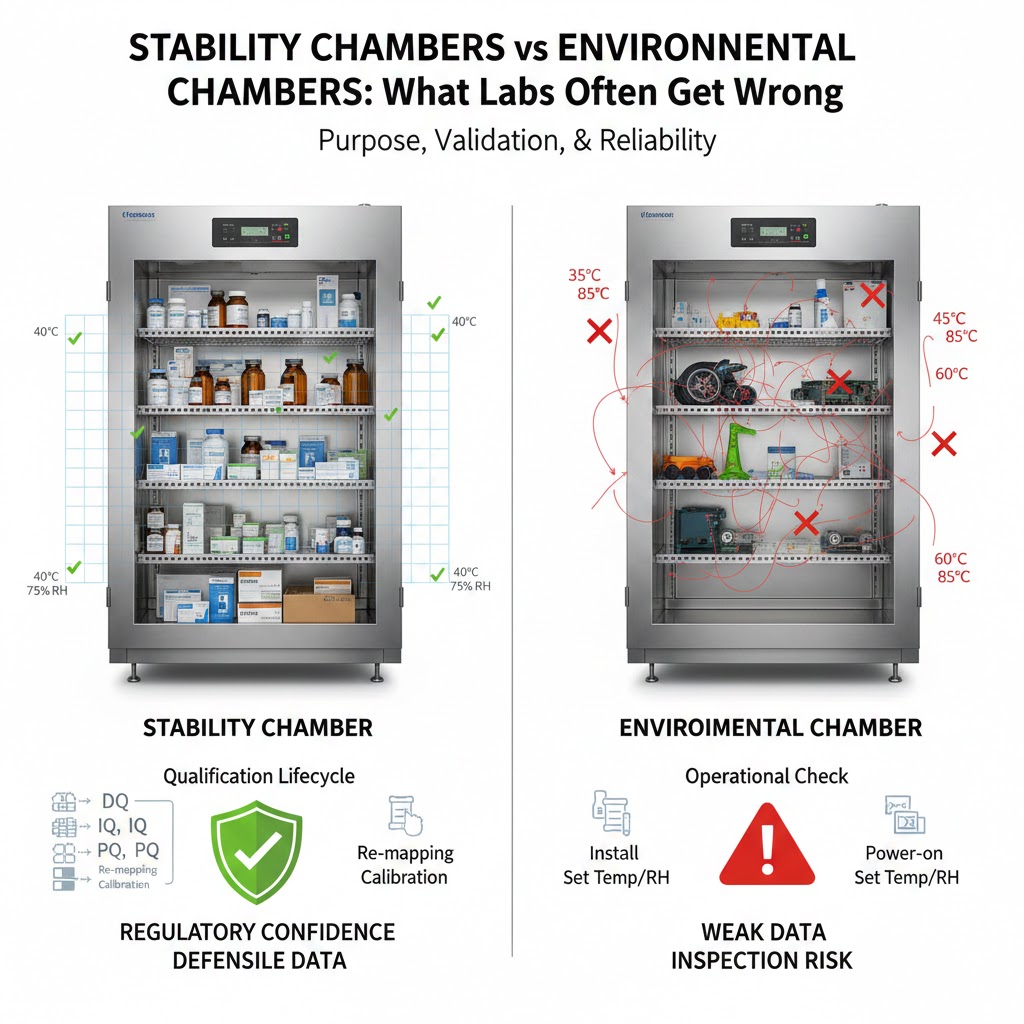
Stability chambers are engineered to maintain uniform conditions across all shelves, under real product load, over extended periods that can last years. Environmental chambers often perform well in short-term or empty-chamber conditions but may show significant variability once shelves are fully loaded.
This difference rarely becomes visible in day-to-day operation — it becomes visible during audits, trend analysis, or regulatory review.
Airflow and Load Behaviour: The Silent Differentiator
Airflow design is one of the most underestimated aspects of stability testing.
In stability chambers, airflow is intentionally balanced to ensure that temperature and humidity remain uniform even when shelves are filled with samples. Performance qualification and mapping are carried out under loaded conditions to confirm this behaviour.
Environmental chambers, however, are often validated without representative load. When products are introduced, airflow patterns can change, leading to micro-environments that compromise study integrity. The chamber may appear compliant, while the data quietly drifts out of scientific reliability.
Validation Depth and Regulatory Expectations
Stability chambers are expected to support a full qualification lifecycle. This typically includes design qualification, installation qualification, operational qualification, and performance qualification, along with periodic re-mapping and calibration.
Environmental chambers are usually qualified only to demonstrate basic operational functionality. While sufficient for research or engineering applications, this level of validation often falls short of what is expected during regulatory inspections for stability data.
This gap is one of the most common reasons stability data is questioned — not because the results are wrong, but because the system producing them cannot be adequately defended.
Data Integrity and Long-Term Confidence
Stability data is rarely reviewed in isolation. It supports regulatory filings, post-approval variations, shelf-life extensions, and market expansion. Regulators assess not just outcomes, but the reliability of the environment that generated them.
Stability chambers are designed with continuous monitoring, alarm management, and long-term drift control in mind. Environmental chambers typically lack the same level of built-in data integrity assurance, making deviation handling and long-term trending more difficult.
When inspections occur, these differences become immediately apparent.
The Hidden Cost of the “Cheaper” Option
Environmental chambers are often chosen for their lower upfront cost or perceived flexibility. However, the long-term risk is rarely considered. Invalidated studies, repeated testing, regulatory questions, and delayed market entry often cost far more than the initial savings.
Stability chambers should be viewed not as equipment expenses, but as risk-control infrastructure that protects both product value and regulatory standing.
Conclusion
Stability chambers and environmental chambers may look similar on the surface, but they serve very different roles in regulated laboratories.
A stability chamber is defined not only by temperature and humidity, but by its ability to deliver:
- Uniformity under real load
- Long-term performance stability
- Robust qualification and mapping
- Defensible, regulator-ready data
Understanding this difference is essential for laboratories that want their stability data to withstand scrutiny, support global approvals, and protect patient safety.
In regulated environments, choosing the correct chamber is not a technical detail — it is a compliance decision.