
More than 25% of temperature-sensitive pharma products experience at least one temperature excursion during storage or transport.
This includes vaccines, insulin, biologics, injectables, and API materials.
A cold chain excursion is not just a temperature spike — it is a potential quality failure, a regulatory red flag, and a logistics risk that can cost millions if not managed properly.
Understanding what actually happens during an excursion — and how to respond — is critical for QA, QC, warehousing, and distribution teams.
What Exactly Is a Cold Chain Excursion?
A cold chain excursion occurs when a product is exposed to temperatures outside its labelled storage range (e.g., 2–8°C, -20°C, 15–25°C).
It includes:
- Overheating (temperature above limit)
- Freezing of items that should NEVER freeze
- RH spikes, often ignored but equally damaging
- Cumulative exposure across multiple small excursions
Cold chain excursions can happen at:
- Airports
- Customs
- Delivery trucks
- Warehouses
- Refrigerators
- Power failures
- Holiday/weekend storage delays
Most excursions happen in the “last mile” — the final 5% of the journey.
What Actually Happens to a Product During an Excursion? (Descriptive Format)
When a temperature-sensitive product experiences a cold chain excursion, the impact isn’t always immediate or visible—but the internal changes can be serious. Here’s what actually happens inside the product during that period:
🔹 1. Chemical Instability Begins
Many biological and pharmaceutical products are highly sensitive to temperature.
When exposed to temperatures above or below the recommended range, their molecules begin to break down, rearrange, or lose structure.
This process is often irreversible—even if the product is brought back to the correct temperature later.
Result: Reduced potency and unpredictable performance.
🔹 2. Protein-Based Products Start Denaturing
Vaccines, monoclonal antibodies, and biologics often contain delicate proteins.
Under heat or excessive cold, these proteins unfold or clump together, losing the shape required to function correctly.
Result: The product may become inactive or even harmful.
🔹 3. Microbial Growth Becomes Possible
For products stored in refrigerated conditions (2–8°C), exposure to warm temperatures encourages faster microbial activity.
Any microbial contamination—previously dormant—can multiply rapidly.
Result: Increased risk of contamination and safety issues.
🔹 4. Physical Changes Appear
Although not always visible, some excursions cause clear physical deterioration, such as:
- Crystallization
- Phase separation
- Changes in color or clarity
- Formation of particulate matter
Result: Visible quality defects that indicate loss of integrity.
🔹 5. Excursion Time Magnifies the Damage
The longer the product is out of the required range, the faster degradation accelerates.
Even a few minutes of exposure can cause damage to ultra-sensitive products like mRNA vaccines, while others may tolerate longer periods.
Result: The risk grows with every passing minute.
🔹 6. Stability Testing Parameters Break
Every temperature-sensitive product is validated through stability studies.
Once temperatures go outside this validated range, the product is considered no longer within its scientifically proven safe zone.
Result: It must undergo risk assessment before use—or be discarded.
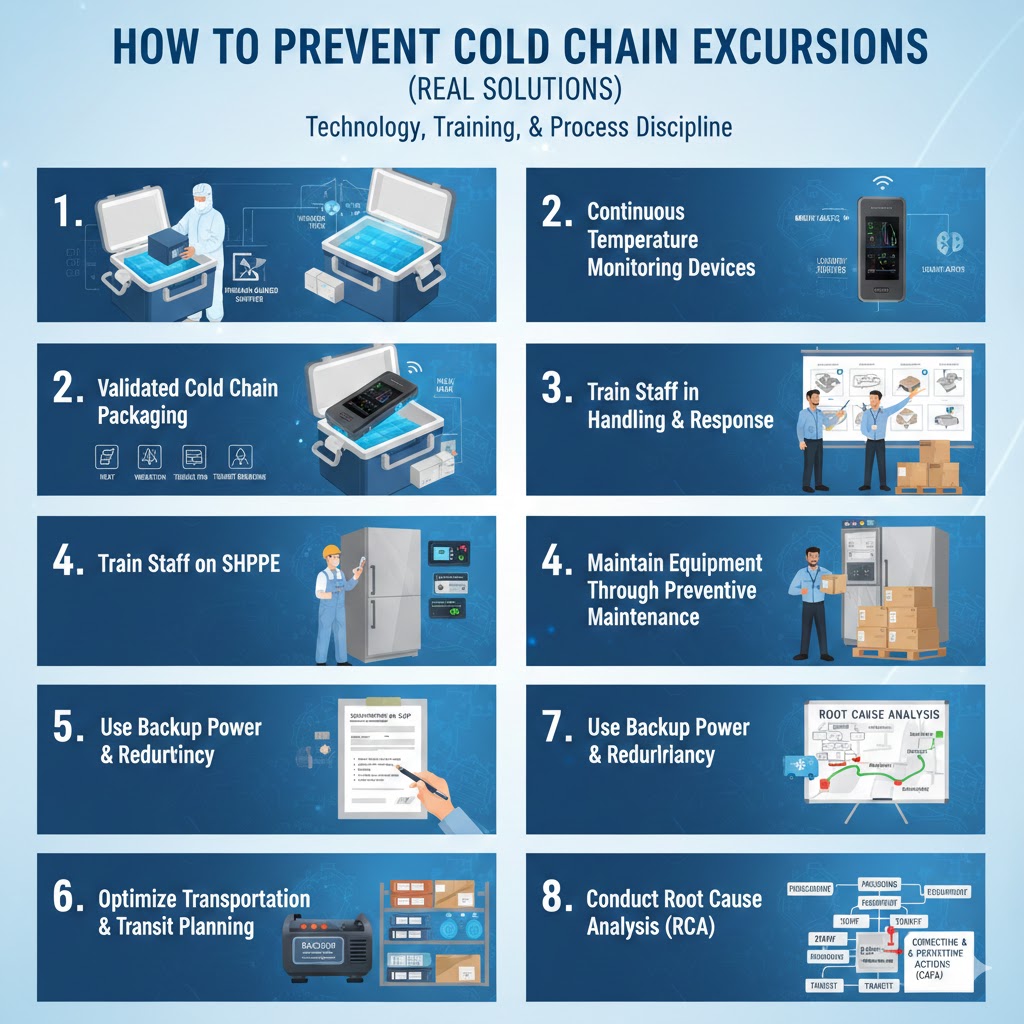
How to Prevent Cold Chain Excursions
Cold chain excursions don’t happen by accident—there is always a failure somewhere in the system. Preventing them requires a mix of technology, training, and process discipline. Here are real, actionable strategies used in pharmaceutical supply chains today:
🔹 1. Use Validated Cold Chain Packaging
Not all coolers, boxes, or ice packs are created equal.
Pharma-grade insulated shippers are tested for:
- Heat exposure
- Vibration
- Long transit durations
- Outdoor handling
These packages maintain temperature using PCM (Phase Change Materials), not normal ice, which melts unpredictably.
Real Impact: Packaging performs reliably even during flight delays or last-mile delivery issues.
🔹 2. Deploy Continuous Temperature Monitoring Devices
Use data loggers, real-time trackers, or Bluetooth sensors inside every shipment.
These devices give:
- Instant alerts when temperature drifts
- Historical temperature reports
- Location tracking
- Door-open detection
Real Impact: Excursions are noticed immediately—not after the product has already spoiled.
🔹 3. Train Staff in Handling & Response Protocols
Many excursions happen because of simple human mistakes:
- Leaving boxes on loading docks
- Keeping refrigerator doors open
- Incorrect use of ice packs
- Poor storage arrangement
Regular training ensures that staff know:
- How to load products
- How to respond to alerts
- How to pack with PCM
- How to record temperature logs
Real Impact: Human error becomes less frequent.
🔹 4. Maintain Equipment Through Preventive Maintenance
Refrigerators, freezers, and cold rooms can fail without warning.
Perform scheduled checks for:
- Door gasket condition
- Temperature uniformity
- Sensor calibration
- Backup battery status
- Power supply reliability
Real Impact: Equipment fails less often, and sudden excursions are prevented.
🔹 5. Implement a Standard Operating Procedure (SOP) for Every Stage
A robust cold chain isn’t just technology—it’s documentation.
Every step—from loading to receiving—should have an SOP that defines:
- Acceptable temperature range
- Packing instructions
- Validation requirements
- Excursion response steps
Real Impact: Everyone follows the same process, reducing variability.
🔹 6. Use Backup Power & Redundancy
Generators, UPS systems, and backup refrigeration units protect products during power outages.
Also, maintain:
- Extra PCM packs
- Backup shippers
- Extra data loggers
Real Impact: The cold chain continues even in emergencies.
🔹 7. Optimize Transportation & Transit Planning
Plan routes to minimize risks:
- Avoid high-traffic hours
- Choose carriers trained in pharmaceutical transport
- Use temperature-controlled vehicles
- Avoid customs delays by pre-documentation
Real Impact: Products spend less time vulnerable to external conditions.
🔹 8. Conduct Root Cause Analysis (RCA) for Every Excursion
If an excursion happens, don’t just discard the product—find out why.
Use RCA techniques to identify:
- Packaging error
- Equipment failure
- Staff mistake
- Transit delay
Then implement corrective and preventive actions (CAPA).
How to Prevent Cold Chain Excursions
Preventing cold chain excursions is not about reacting when something goes wrong — it’s about building a system where failures have no opportunity to occur. A strong cold chain relies on a combination of smart technology, disciplined processes, and well-trained people. Here is how pharmaceutical companies realistically avoid excursions at every stage of the supply chain:
A major part of prevention starts with validated packaging. Unlike ordinary coolers or ice boxes, pharmaceutical insulated shippers are engineered to perform in extreme real-world conditions such as flight delays, warehouse heat, and long transit durations. They use phase change materials (PCMs) that hold temperatures steady for predictable durations. When packaging is properly validated, the product remains protected even when external conditions fluctuate wildly.
Real protection also depends heavily on continuous temperature monitoring. Modern cold chain shipments no longer travel blind—tiny data loggers or real-time GPS trackers sit inside every box. These devices record temperature throughout the journey and instantly alert the team if a deviation begins. Instead of discovering a problem after the shipment arrives, stakeholders can intervene mid-transit, preventing minor drifts from becoming full excursions.
However, technology alone is not enough. Many excursions are caused by simple human mistakes: leaving packages on the loading dock too long, opening refrigerator doors unnecessarily, incorrect PCM placement, or poor stacking. That’s why regular staff training becomes a frontline defense. When warehouse teams, drivers, and handlers understand correct loading, packing, and emergency response steps, the chances of an avoidable excursion drop dramatically.
Cold chain reliability also depends on the health of the equipment behind it. Refrigerators, cold rooms, reefer trucks, and freezers can fail suddenly if not properly maintained. Through preventive maintenance, companies routinely check sensor accuracy, door seal integrity, compressor performance, and backup battery life. These small, scheduled checks often stop major failures before they occur.
To tie everything together, organizations establish detailed Standard Operating Procedures (SOPs). These SOPs outline everything from acceptable temperature ranges to packing instructions to the exact steps to follow during an excursion. When everyone follows the same documented process, there is far less room for inconsistency.
Finally, a strong cold chain is built on redundancy and planning. Backup power systems, spare PCM packs, additional validated shippers, extra data loggers, and pre-planned transport routes ensure that a single delay or breakdown does not compromise the product. Even when an excursion does occur, companies perform root cause analysis (RCA) to understand what failed and implement corrective and preventive actions so the same issue never repeats.
In essence, preventing cold chain excursions is about creating resilience at every stage — packaging, monitoring, people, equipment, processes, and emergency readiness. When all these elements work together, the cold chain becomes stable, predictable, and trustworthy.
Conclusion
Cold chain excursions are not random accidents — they are signals that something in the system needs attention. When temperatures drift, it isn’t just the product that’s at risk, but patient safety, regulatory compliance, and millions in inventory value.
Building a resilient cold chain means thinking beyond transport boxes and refrigerators. It requires a coordinated ecosystem of validated packaging, real-time monitoring, trained personnel, disciplined SOPs, preventive maintenance, and strong backup planning. When these elements work together, excursions become rare, predictable, and manageable.
In a pharmaceutical world where every degree matters, the companies that invest in cold chain precision are the ones that earn long-term trust — from regulators, partners, and most importantly, the patients who depend on safe, effective medicines.