
Introduction
When we place pharmaceutical products inside a stability chamber at 40°C and 75% RH, we’re not just “testing shelf life.”
We’re recreating the most extreme real-world environments a drug may face — hot warehouses in India, humid ports in Southeast Asia, monsoon storage conditions, and long logistics chains.
But what really happens inside the chamber?
Why do some tablets crack while others swell?
Why do capsules become sticky?
Why do suspensions change viscosity?
Why do some formulations survive, while others fail in weeks?
1. The First Hour: The Drug Meets the Environment
Temperature Shock
As the product moves from ambient conditions (typically 24–30°C) to 40°C, the first change is thermal stress:
- Semi-solids thin out as viscosity drops.
- Coated tablets expand microscopically.
- Gelatin capsules soften slightly.
Nothing catastrophic yet — but the “stress clock” starts ticking.
Humidity Absorption Begins (Even in Sealed Packs)
75% RH is extremely high, and moisture begins diffusing through:
- PVC/PVDC blisters
- HDPE bottles
- Even foil laminates (unless high barrier)
Water vapor pressure difference forces moisture into the pack.
This is the beginning of moisture stress.
2. The First Week: Chemistry Starts Reacting
At this point, degradation pathways activate:
Hydrolysis Accelerates
Drugs containing esters, amides, β-lactams, and lactams begin to break down.
Examples:
- Aspirin → salicylic acid
- Penicillin → penicilloic acid
- Nifedipine → nitrosophenyl derivative
Oxidation Speeds Up
Heat accelerates oxygen attack even inside sealed packs.
Sensitive drugs:
- Vitamin C
- Adrenaline
- Paracetamol intermediate species
- Many biological actives
Packaging Begins to Show Stress
- Blister pockets expand slightly.
- Bottles build internal moisture load.
- Desiccants reach saturation faster.
3. The First Month: Physical Changes Become Visible
Now the real visual symptoms show up.
Tablet Hardness Drops or Increases
- High humidity causes tablets to swell and soften.
- Heat causes binders to tighten, increasing hardness.
Both changes disrupt dissolution profiles.
Capsule Shell Deformation
Gelatin absorbs moisture rapidly:
- Capsules become soft, sticky, or distorted.
- They may clump together.
- In extreme cases, shells crack during transport simulation.
Coatings Begin to Fail
Moisture penetrates the polymer layer:
- Coatings peel
- Orange peel effect
- Color migration
- Surface tackiness
Suspensions Change Viscosity
The thickening agents lose structure.
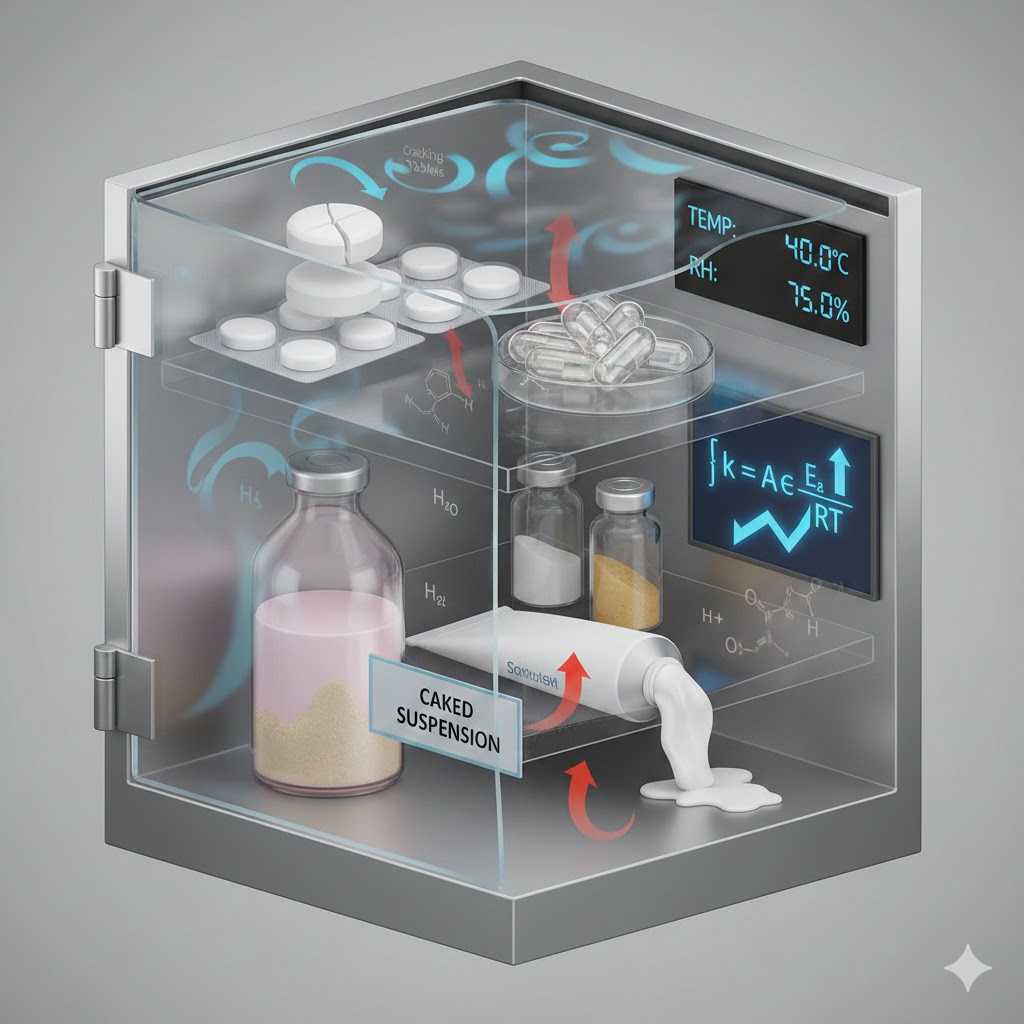
4. Months 2–3: Product Integrity Is at Risk
This is the point where formulations start failing ICH acceptance criteria:
Dissolution Failures: Moisture alters disintegrants and binders → the drug releases too slow or too fast.
Assay Dropping Below Limits: Hydrolysis + oxidation cause assay values to drop below 90%.
Impurity Profile Changes: New degradation products appear — often at 40°C they form faster than real shelf life.
Microbial Growth Risk for Moisture-Sensitive Forms: For aqueous products or hygroscopic powders, high RH becomes a risk factor.
This is why accelerated studies at 40°C/75% RH predict real-world failures early.
5. Months 3–6: Packaging Determines Survival
Now the packaging becomes the hero or the villain.
If packaging is good (ALU-ALU / high barrier foil):
The product stays stable.
Moisture ingress is minimal.
Dissolution and assay remain within limits.
If packaging is weak (PVC, low PVDC, HDPE bottle with loose cap):
- Moisture accumulates
- Assay drops rapidly
- Impurities exceed limits
- Formulation collapses
At this stage, many products fail long-term projections if the packaging isn’t optimized.
Conclusion
A 40°C/75% RH stability chamber isn’t just a stress test — it’s the ultimate truth serum for pharmaceutical products. Under these extreme conditions, every weakness surfaces: chemical instability, moisture-driven degradation, packaging failure, and even the smallest formulation imbalance.
What survives here isn’t just “stable.”
It’s globally qualified.
This single chamber determines whether a drug can:
- Maintain potency across climates
- Withstand humidity-driven breakdown
- Survive long supply chains
- Meet ICH regulatory demands
- Earn global shelf-life approvals
In other words, stability data under 40°C/75% RH shapes everything — from formulation to packaging, from labeling to logistics, and from regulatory submissions to patient safety.
Mastering stability at these conditions isn’t optional.
It’s the difference between a product that works in the lab…
and a product that works everywhere.