
Introduction
Stability chambers have long been the silent workhorses of the pharmaceutical industry—running 24/7, year after year, to ensure that every medicine on the market remains safe, effective, and compliant throughout its shelf life. From tablets and vaccines to biologics and cosmetics, stability chambers simulate real-world storage environments, allowing scientists to understand how temperature, humidity, and light affect product quality over time.
But in the last five years, something dramatic has changed.
The pharma industry is undergoing an unprecedented transformation driven by digitalization, stricter global regulations, rapid drug development cycles, and the rise of personalized medicine. Regulatory bodies like the US FDA, EMA, MHRA, and CDSCO are demanding greater data integrity, traceability, and control than ever before. At the same time, manufacturers are managing hundreds of concurrent stability studies across locations, products, and timelines.
Traditional stability chambers—relying on manual monitoring, basic sensors, and periodic checks—are no longer enough.
This shift has led to the rise of Smart Stability Chambers: next-generation systems infused with IoT sensors, automated control loops, cloud dashboards, AI-driven predictions, and energy-optimized engineering. Instead of simply “holding” a temperature and humidity, these chambers now play an active, intelligent role in monitoring, preventing deviations, improving compliance, and protecting millions of rupees worth of samples.
The move toward smart chambers is not just a technological upgrade.
It represents a fundamental shift in how pharmaceutical companies approach stability studies:
- From manual supervision → to autonomous monitoring
- From reactive troubleshooting → to predictive maintenance
- From paper-based logs → to real-time, audit-ready data
- From isolated chambers → to fully connected, enterprise-wide visibility
As India’s pharmaceutical sector grows into a global manufacturing and R&D powerhouse, the demand for smarter, more reliable, and more compliant stability systems has skyrocketed.
What Makes a Chamber “Smart”?
A smart stability chamber goes far beyond holding temperature and humidity. It uses integrated digital systems to monitor, predict, and prevent issues before they impact your samples. Here’s what sets it apart:
IoT-Enabled Real-Time Monitoring
Smart chambers are equipped with high-precision IoT sensors that track temperature, RH, pressure, and airflow every second.
The system sends continuous data to a centralized dashboard, providing full visibility across all chambers in the facility.
Instead of manual checks every few hours, deviations are detected instantly — even minor fluctuations of ±0.1°C or 1% RH.
Alerts are pushed through SMS, email, or app notifications, reducing the risk of unnoticed excursions.
This level of monitoring ensures tighter control, improved audit readiness, and full traceability across every minute of the study.
Predictive Maintenance (Not Reactive)
Smart chambers continuously analyze their own performance parameters — compressor behavior, energy load, humidity drift, motor vibrations, and fan speed.
Machine-learning algorithms detect patterns indicating early failure, allowing maintenance teams to intervene before downtime occurs.
This prevents sudden breakdowns that can ruin long-term studies and cause costly sample loss.
Predictive alerts also help optimize spare-part planning and reduce emergency service calls.
Over time, the system learns the chamber’s operating rhythm, making predictions smarter and more accurate.
Cloud-Based Data & 21 CFR Part 11 Compliance
Smart chambers automatically log thousands of data points per day and upload them securely to cloud-based audit systems.
All records are time-stamped, encrypted, and version-controlled, ensuring authenticity and preventing tampering.
User access is governed through multi-level logins, electronic signatures, and role-based privileges.
This eliminates manual logbooks, reduces human error, and ensures every data point is traceable — a major advantage during FDA/WHO audits.
The cloud creates a single source of truth, accessible anytime, with built-in redundancy and automatic backups.
Intelligent Control Systems
Smart microprocessors constantly analyze internal conditions and adjust temperature, humidity, and airflow within milliseconds.
Even when the door is opened or load changes, the system restores stability faster than traditional chambers.
Uniformity across shelves and corners is maintained through intelligent airflow mapping and adaptive fan cycles.
These chambers also compensate for external variations in ambient temperature, voltage fluctuations, and mechanical load.
The result: tighter tolerances, ultra-stable conditions, and more reliable stability study results.
Energy Optimization
Smart chambers use energy-efficient algorithms that optimize compressor cycles, heater output, and humidification rate.
They adapt to usage patterns — lowering energy consumption when conditions are stable or during non-peak hours.
Advanced insulation, inverter technology, and low-power standby modes can reduce electricity consumption by 15–30%.
Energy-efficient operation also lowers heat emission, reducing load on HVAC systems and improving overall facility sustainability.
This is increasingly important for pharma manufacturers aiming for greener operations and lower OpEx.
Remote Access & System Health Monitoring
Smart chambers allow users to view live data, historical graphs, alerts, and chamber health from anywhere — phone, tablet, or laptop.
This gives QA teams, plant heads, and regulatory managers complete oversight without needing to be physically present.
Remote diagnostic tools allow service engineers to troubleshoot issues instantly, reducing downtime.
Managers can compare performance across multiple sites, brands, and models for better decision-making.
This level of accessibility enables faster responses, greater efficiency, and seamless teamwork across departments.
Why Smart Chambers Are Becoming the New Pharma Standard
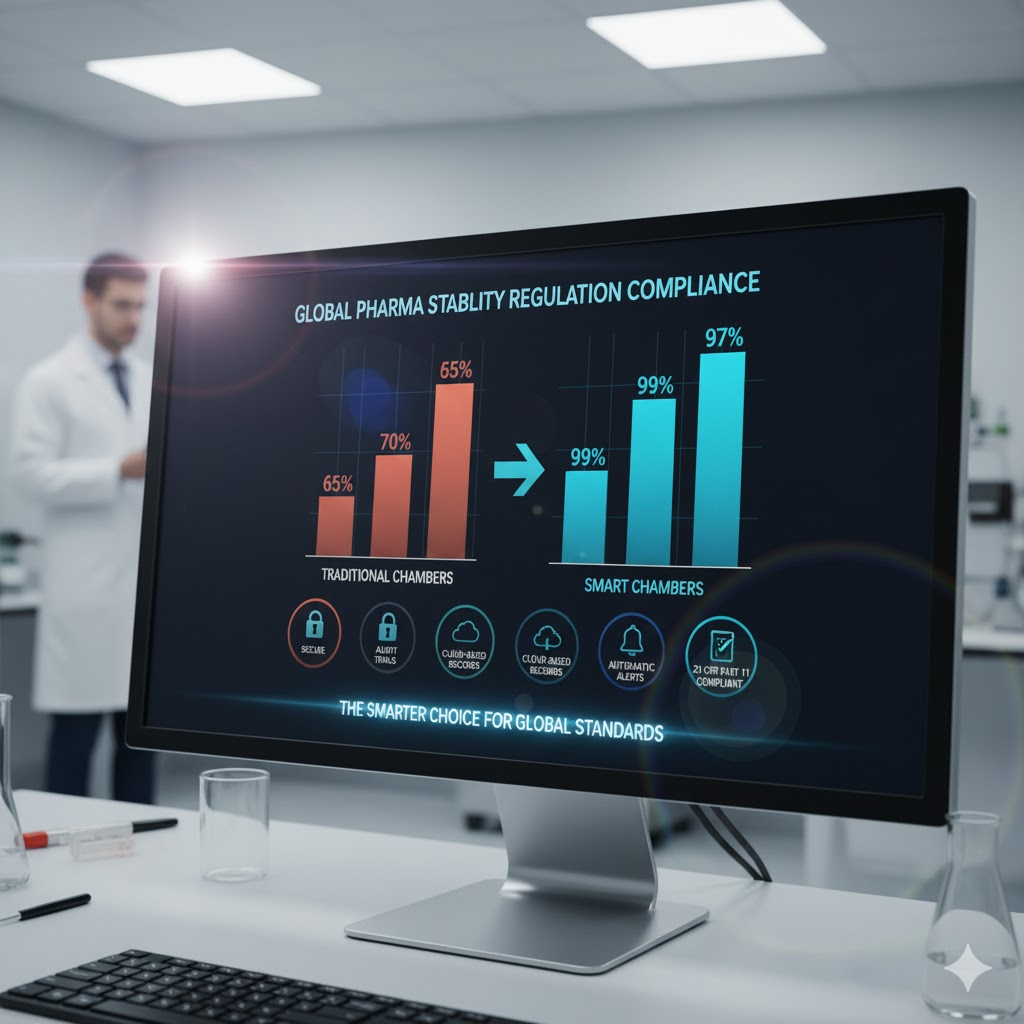
Increasing Regulatory Pressure (ICH Q1A, WHO, USFDA, EU GMP)
Global regulators now expect more than just “stable” temperature and humidity — they expect continuous proof of stability.
Smart chambers meet this requirement automatically with:
- Continuous data logging
- Secure audit trails
- Automatic deviation alerts
- Cloud-based 21 CFR Part 11–compliant records
Regulators worldwide now check how data is collected, not just what the data says — making smart systems the safer choice.
Complexity of Modern Drug Formulations
The pharma pipeline is shifting toward:
- High-potency drugs (HPAPI)
- Biologics
- Peptides
- mRNA-based formulations
- Temperature-sensitive vaccines
These molecules are significantly more sensitive to micro-variations in RH and temperature.
Smart chambers maintain tighter control and deliver ultra-precise uniformity, making them ideal for the next generation of therapies.
Rising Cost of Product Losses & Recalls
Worldwide pharma product losses cross $35–40 billion annually, largely due to temperature and humidity excursions.
Smart chambers minimize losses through:
- Predictive maintenance
- Instant excursion alerts
- Precise control even in harsh ambient conditions
For manufacturers, even preventing one batch loss often justifies the investment in smart technology.
Conclusion
Smart stability chambers are no longer futuristic upgrades — they are the new operational backbone of modern pharmaceutical quality. As regulatory expectations rise, formulations become more sensitive, and global supply chains grow more complex, the ability to control, monitor, and document environmental conditions with precision has become essential, not optional.
Smart chambers deliver exactly that: tighter accuracy, stronger data integrity, lower risk, fewer losses, and faster audits. For Indian manufacturers and global pharma alike, they offer a strategic advantage — enabling compliant studies, smoother inspections, and more resilient products built for real-world conditions.
In a world where every degree and every percentage of RH can impact patient safety and business value, the organizations that adopt smarter environmental control today will define the quality standards of tomorrow.